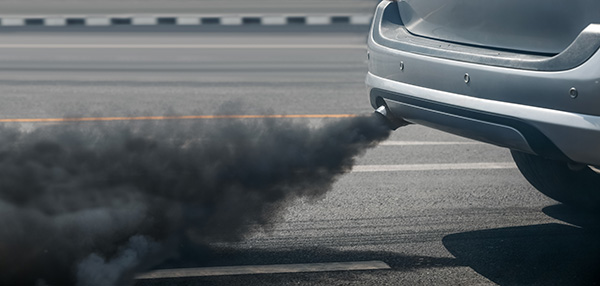
Seeing thick black smoke coming from your exhaust is one of those moments that gets your attention immediately. At our shop, when a customer describes this, we know they are usually worried for good reason. Black smoke is not something most drivers would call normal, and in most cases, it is your vehicle’s way of saying the engine is burning too much fuel.
That matters because your engine is supposed to run with a careful balance of air and fuel. When that balance gets thrown off and the engine starts running too rich, the exhaust can turn dark and smoky. The smoke may come and go at first, or it may be obvious enough to make you nervous every time you accelerate. Either way, it is a sign that something is not working the way it should.
The good news is that black smoke usually points us toward a fairly specific type of problem. The less good news is that it can lead to poor fuel economy, rough performance, and more expensive damage if it keeps happening for too long.
What Black Exhaust Smoke Usually Means
In simple terms, thick black smoke usually means the engine is getting more fuel than it can burn cleanly. Instead of using the fuel efficiently, the engine sends part of that unburned or poorly burned fuel out through the exhaust. That is what creates the dark smoky look.
At our shop, we often explain it like this. The engine is running too rich. There is too much fuel in the air and fuel mixture, and the combustion process is no longer as clean as it should be.
That kind of imbalance can happen for several different reasons, but the basic message is usually the same. The engine management system is not getting the mixture right.
A Rich Fuel Mixture Is The Biggest Clue
A rich mixture can come from several places. Sometimes a sensor is reading incorrectly and telling the engine to add more fuel than needed. Sometimes an injector is leaking or flowing too heavily. Sometimes a restriction in airflow means the engine is getting enough fuel but not enough air. In every case, the end result is similar. The engine ends up with more fuel than it can handle efficiently.
That is why black smoke is such a useful clue. It points us away from some problems and toward others very quickly.
A Dirty Or Restricted Air Filter Can Be Part Of It
One of the simpler causes of black smoke can be poor airflow. If the engine cannot get enough clean air because the air filter is heavily clogged, the fuel mixture can become richer than it should. The engine is still receiving fuel, but it is not breathing the way it needs to.
This does not mean every dirty air filter will create dramatic black smoke, but it is absolutely one of the things we want to inspect early in the process. It is also one of the more manageable problems if it is caught before it starts affecting the engine more seriously.
Fuel Injectors May Be Delivering Too Much Fuel
Fuel injectors are designed to deliver a very precise amount of fuel. If one starts leaking, sticking, or spraying improperly, the engine may get more fuel than it should in one or more cylinders. That can lead to a rich condition and black smoke from the exhaust.
In some cases, bad injector behavior also comes with other symptoms like rough idle, poor fuel economy, hard starting, or hesitation. At our shop, when black smoke shows up alongside those issues, injectors are definitely part of the conversation.
A Sensor Problem Can Throw The Whole Mixture Off
Modern engines depend on sensors to make constant fuel adjustments. If one of those sensors is feeding the computer bad information, the engine may respond by adding too much fuel. A faulty mass airflow sensor, oxygen sensor, coolant temperature sensor, or manifold pressure sensor can all contribute depending on the vehicle and the exact failure.
The reason this matters is that the smoke is often only the visible symptom. The real problem may be an engine control input that is quietly sending the system in the wrong direction.
At our shop, this is why diagnosis matters so much. You do not want to guess at parts when the real issue may be buried in the data the engine computer is trying to use.
Diesel Vehicles Can Have Their Own Causes
If the vehicle is diesel, black smoke can still point to excess fuel, but the list of likely causes can shift a little. Diesel engines can produce black smoke from injector issues, turbocharger problems, air intake restrictions, EGR issues, or other system faults that affect combustion quality.
The basic theme remains the same. Something is causing incomplete or excessive fueling. The exact path to that result just depends on the engine design.
Poor Fuel Economy Often Follows
One of the most common side effects of black smoke is poor fuel economy. That makes sense when you think about it. If the engine is burning too much fuel or failing to burn it efficiently, you are going to use more gas or diesel than normal.
A lot of drivers notice this before they fully understand what is going on. They find themselves filling up sooner, then later notice the smoke, rough running, or check engine light that helps complete the picture.
You May Also Notice Rough Performance
Black smoke often comes with other drivability complaints. The engine may feel sluggish, rough, hesitant, or less responsive than usual. In some cases, acceleration feels lazy. In others, the engine may stumble, run unevenly, or smell strongly of fuel.
A few common signs that may show up with black smoke include:
- Poor fuel economy
- Rough idle
- Sluggish acceleration
- Strong fuel smell
- Check engine light
- Sooty buildup around the exhaust tip
When several of these show up together, the need for diagnostics becomes much more urgent.
Why You Should Not Ignore It
A lot of people hope black smoke is a temporary quirk that will pass. We do not recommend counting on that. An engine that is running rich can do more than waste fuel. Over time, it can foul spark plugs, contaminate engine oil, damage emissions components, and put extra stress on the catalytic converter. At our shop, if a vehicle is blowing thick black smoke, we look at it as a problem that deserves real attention sooner rather than later.
When It Is Time To Stop Driving And Get Help
If the black smoke is heavy, constant, paired with poor running, or accompanied by a check engine light, it is smart to stop treating it as something minor. The vehicle may still move, but that does not mean it is healthy to keep driving that way for long.
You should be especially cautious if the smoke gets worse under acceleration, the engine feels weak, or there is a strong fuel smell coming with it. Those clues usually mean the issue is active enough to affect both performance and engine health.
The Best Way To Solve It Is With Proper Diagnosis
Black smoke is one of those symptoms that may look obvious but still has multiple possible causes. Replacing random parts because the smoke seems fuel related is not usually the smartest path. A good diagnosis looks at scan data, airflow information, sensor readings, fuel delivery, and overall engine behavior to find the real cause.
If thick black smoke is coming from your exhaust, bring your vehicle to Cottman of Waldorf in Waldorf, MD as soon as possible. We can inspect the engine, diagnose why it is running rich, and help fix the issue before it turns into bigger damage and a much more expensive repair.